The Ocean Collection
Background/ Designer Purpose
It's not surprising that the fashion industry is wasteful. From chemical dyes to synthetic fibers, most garments live a single life. In other words, factories are using raw materials to fulfill orders that often end up tossed aside (trash or closet). But thanks to today's trends, people are pushing to shift this linear mindset and develop a more circular one. This is where thrifting and up-cycling has come into play, the idea of taking existing fabrics or garments and then reconstructing them to form new ones. As a designer the concept of manipulating and redefining materials to create new functional products is interesting. As environmental scientists have urged the public to acknowledge their impacts and reduce their ecological footprint, recycling materials is a tangible solution.
Thus, my collection highlights the potential of everyday materials. To do so, I chose to approach materials analytically. By identifying a materials current properties and manipulating it to display new characteristics and create unexpected structures, I hope to illustrate that even materials we know everything about can still be transformed in surprising ways.
"The Ocean Collection"
Originally commissioned by Scarlette Magazines to create a collection inspired by the ocean and recent environmental issues, I was happy to create my interpretation. As a nature lover, chemical engineer, and fashion designer, I have see this issue from many perspectives and was excited to bridge them together. For me, the ocean symbolizes life and beautify. Picturing the carbon or animal life cycle in the water, I believe the way to solve pollution is not to add more chemical or machines into the water but to follow the cyclic process and build solutions from existing materials. Therefore each piece within this collection not only reflects the beauty, fluidity, and diversity of the ocean but also illustrates a possible solution to redefining/ recycling these pollutants.
Collection Pieces
Each of these garments are made completely out of only plastic grocery bags, packaging tape, fishnets, and wire. While not obvious from the photo's, I created a crackled like texture on the plastic bags surface for all the peices. This was to reduce the amount of light reflected during photoshoots and it make the plastic look more natural and water like. Furthermore, each dress contains a wire outlining or frame to provide support and decrease the stress on the plastic bags when worn. Overall, I am proud of this collection and think each piece tells its own story why still maintaining the cohesive theme. Enjoy!

Originally designed for Columbus Fashion Week 2024, this dress is constructed completely out of plastic bags and has circular supports made of wire. Furthermore, it features 500+ scales that ombre from white to blue, mimicking the ocean's waves. In addition to the color, the shape of each scale is organic and unique rather than perfectly circular. This detail allows the petals and the color gradient to transition smoother create a water-like texture. Another hidden detail is revealed when air is blown on the dress or when the model walks. As a result, the petals ripple and ruffle with movement, simulating the fluidity and water-like movement of the ocean. What makes this dress special compared to the other pieces in this collection is after the show, many models, photographers, and audience members approached me asking me what the dress was made from. This initially surprised me as I thought it was obvious the dress was made from grocery bags but because I had created a structure and texture that deviates from typical imagined plastic bag dresses and used techniques that I invented, people were surprised.


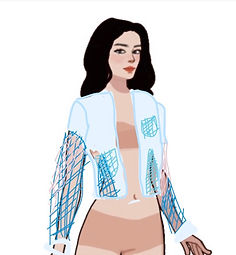
This jacket was built using the same techniques as the other pieces in this collection. The plastic is lined with packaging tape and the edges are reinforced with wire. But when considering functionality, I had to figure out how to construct the sleeves so that they would allow movement in the arms. My solution was these intentionally placed slits with fishnets holding them together. Doing so, the arms are able to extend and constrict without worrying about tearing the plastic.
Oringinally designed for a male model, I wanted to created a gender neutral garment that would be able to fit any body type. Pulling inspiration from the structure and style of thick cargo or fishermen coats, I wanted to adapt it to the theme. Therefore my design has cut outs and fishnet draping giving the illusion that this jacket was either washed up on the shore or created in the ocean from its pollution.


This top is also made from plastic bags. tape, and wire. Additionally, I built in foam cups or padding since the plastic way translucent. The ruffled cup designs are meant to imitate sea shells, and I wanted a unique bodice shape with a round cut out to smoothen the design. Furthermore, the back has grommets and a lace up closing also stabilized with wire.


This skirt was meant to be paired with the sea shell cup top but can also be styled on its own. It features an asymmetrical cut allowing more coverage in the back. The fishnet overlay in a sense encase the legs similar to a fishing net. The plastic was again stabilized with tape and wire was used to line the edges and build support for the main body of the skirt. Additionally, there is a wire ring at the bottom of the netting. This ring helps push the fishnets away from the legs and prevents the wearer from tripping on the nets. This this is a functional and structural detail. The back of the skirt is also closed with a lace up panel. To style this skirt, there are loose pieces of the fishnets that can create a train in the back or trapped around the body.

The final garment of this collection, this top is created following the same processes as the others. Similarly, the simple bandeau plastic top has a lace up panel on the back. The inspiration for this top came from ocean life. The ocean has countless freshwater to salt water biomes that house ecosystems where diverse species coexist. In my design, I wanted to bring these organisms to life. By have 4 single threads dangling under the top, it is meant to mirror ribs or bones. Furthermore, the top has off the shoulder sleeves. When the arms are raised, these sleeves will drape and create webbing between the arm and the body.


Design Process
1. Inspiration
Every collection starts from ideas. For this collection, Scarlette magazines sent me their initial inspiration and a general topic they wanted me to pursue. I took these ideas and extended them to create my theme for this collection. Here are some images that I was inspired by when deciding color palates, textures, and structures for my garments
2. Rough Sketches
The next logical step is to take the inspiration and transform them into my own ideas. Thus I played around digitally and created basic sketches that served as a base line for what I planned to create. These sketches can be easily altered and redrafted.



3. Draping
After settling on my favorite sketches, I will start to bring these drawings to life. To start, I need to create 2d patterns. My favorite way is drafting. Here, I'll start with red string to outline the shape of the garment and then separate the garment into sections that I know will lay flat when cut out. Thus curvier regions will require smaller pieces to lay flay. Sometimes slits or darts have to be included in order to create the shape.
Then I dropped fabric over the sections to outline the shapes and cut out these pieces to form patterns that when combines should align and create the garment.


4. Material prep

To be able to manipulate the plastic bags like fabric, I had to stabilize them. First I cut them into flat panels and then taped the back side of each to stabilize. The tape will prevent the plastic from warping or stretching as it is used. Furthermore, the tape was used to texture the bags as it added a water/ ice like crackling. This was purposeful so that when the garments are under lightings or flash photography, the garments would not reflect the light and could be photographed well. The texture also adds character to the garment.

5. Pattern Pieces
With the flat 2d pattern, I will adjust sharp edges, redraft areas that no longer align, or problem solve any other issue that may arise. With the finished pattern, I then cut them out of my plastic material to create the pieces of the dress.


6. Combining pattern pieces


This step is where I assemble the base of the dress. I opted to tape them together to create a seamless finish between panels. The packaging tape also has a strong hold on the plastic so I knew the connections would be secure. I chose not to sew since constantly sewing through tape would leave my needle sticky and unusable for other projects plus the thread seams would be noticeable.
During this step, I will move backward and forwards, alternating between the last step to adjust the 2d pattern as I asses its fit when combining pieces.
7. Reinforcing with wire

After all the pieces are combines and the base is complete. I outlined each edge with wire to prevent tearing since the edges of a garment undergo the most stress. Based on the garment, I added additional wire as structure. For examples, the floor lengthen gown has circular wire supports under the skirt so that the skirt will not collapse in on itself and so the petals lay flat as the dress moves. Additionally, the sea shell top has wire undertake cups for support and the skirt has a circular wire support at the bottom of the fishnets to the model does not trip on the nets when she walks.


8. Lace up panels
To close the garments, I opted for lace up panels and modesty panels that lay under the lace up to conceal the opening. I chose lace up as opposed to zipper, button, or velcro since I thought it would be the best for the material used (less stress, easier to work with, look the cleanest). To create the lace up panels, I outlines the edges with wire to relive the stress on the grommets. In fear that the grommets would endure so much tension from the string that they would rip off the plastic, I added wire lining to help hold the garments in and distribute the tension.


9. Adding fishnets or scales
For the fishnet dresses, I added grommets for the fishnets to ties and attach to. I draped the fishnets according to my design. cups were also added to the sea shell top with tape.


For the floor lengthen gown, I cut petals from plastic, figured out how to overlap and ombre them from white to blue since I only had 4 colors to work with, and then attached them with tape at the top so that the petals could be lifted but were also secure. I started placing petals from the top to bottom and placed each row over lapping in alternate directions. Furthermore, the lace up panels were carefully concealed behind the scales.


Columbus Fashion Week
Similar to New York Fashion Week, Columbus Fashion Week is an annual week long event that host 7+ fashion shows a year, showcasing professional fashion designer newest collections from Ohio or across the country.


Hair and Makeup
The Runway


Photoshoot
Similar to New York Fashion Week, Columbus Fashion Week is an annual week long event that host 7+ fashion shows a year, showcasing professional fashion designer newest collections from Ohio or across the country.
As a designer for Fall 24, Scarlette Magazines interviewed me about my design for their article covering the shows.
Click the link to read the article.


Scarlette Magazine's Fall/ Winter 24 "Sustainability" issue highlighted specific weak points in the fashion industry that are negatively impacting society or the environment. The article "Integrating the blue economy into fashion for a greener, or bluer, future" covers all the plastic, chemical, or fabric pollutants from fashion that end up trashing the ocean.
As a designer who works with unconventional materials, Scarlette Magazines commissioned me to create 5 garments utilizing plastic bags and fishnets to represent these pollutants as well as illustrate through recycling these materials back into clothing that we are not too late and can find solutions to clean up the ocean.
Click the link to read the article.


